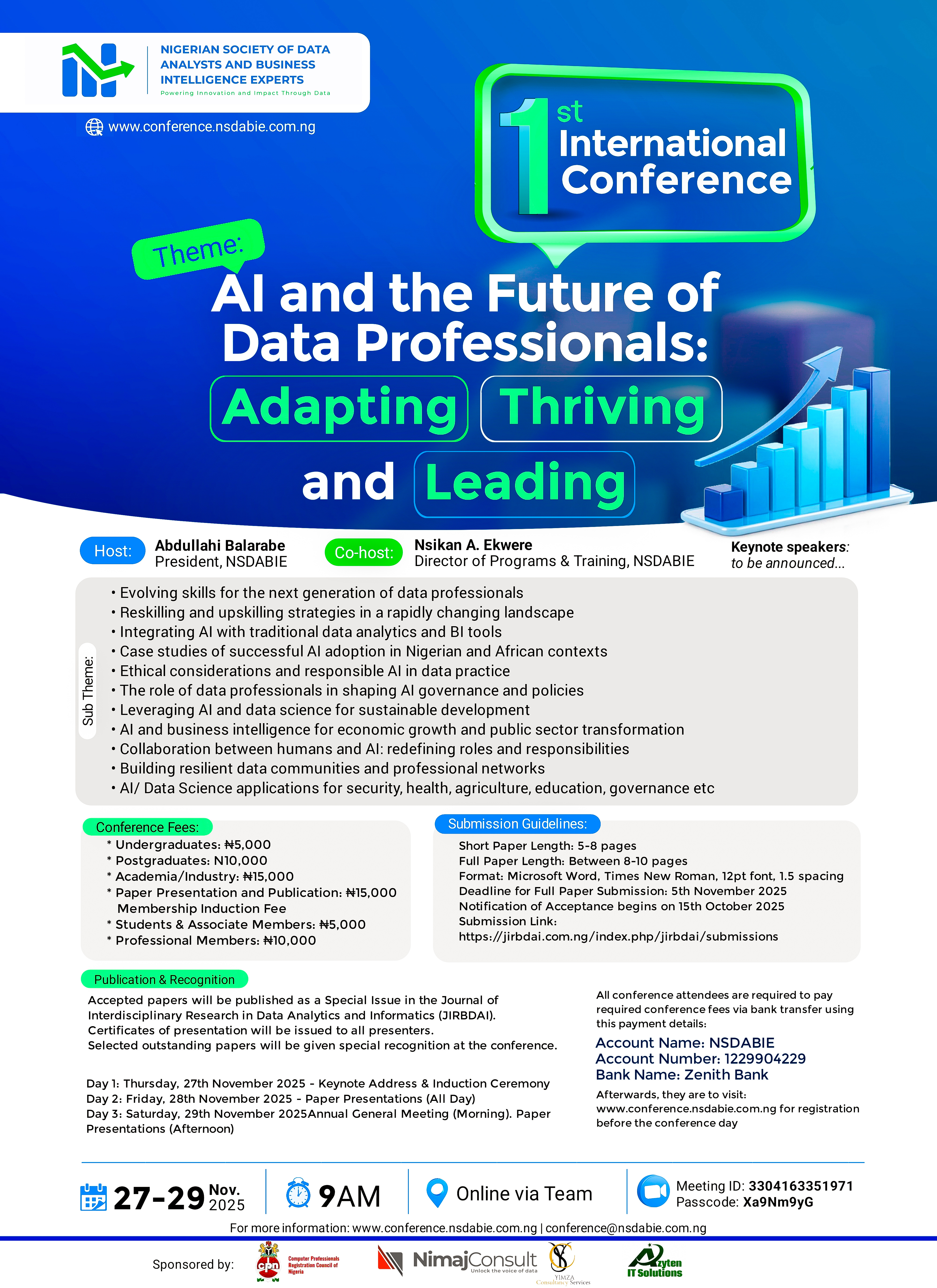
AI and the Future of Data Professionals: Adapting, Thriving, and Leading through Multimodal Healthcare AI
Keywords:
Artificial Intelligence, Data Professionals, Multimodal healthcare, Alzheimer's Disease, Machine Learning, Deep learning, Healthcare Innovation, Explainable AIAbstract
Artificial intelligence (AI) is quickly transforming healthcare, with multimodal methods opening new opportunities for early diagnosis, precision medicine, and clinical decision-making. Neurodegenerative diseases like Alzheimer’s highlight both the huge potential and the major challenges of this change. Traditional diagnostic tools such as imaging, biomarker testing, and cognitive assessments are still limited by high costs, restricted access, and inconsistent results. Multimodal AI, which combines different data sources like imaging, genomics, patient records, and digital biomarkers, provides a promising path toward earlier and more accurate disease detection. This paper examines the evolving role of data professionals as key architects of multimodal healthcare AI. Their contributions extend beyond developing algorithms; they are tasked with integrating complex datasets, protecting privacy and fairness, and leading the development of transparent, trustworthy systems. The review highlights key technical challenges, including heterogeneous data, incomplete information, and computational demands, as well as ethical concerns such as privacy, fairness, and regulatory gaps. It also discusses workforce barriers, from skill shortages to resistance within healthcare environments. Additionally, it points to future directions, such as transformer-based models for multimodal fusion, federated learning for privacy-preserving collaboration, wearable and IoT technologies for continuous monitoring, and explainable AI to foster clinical trust. By framing data professionals as both technical innovators and strategic leaders, this paper emphasizes that the future of healthcare AI will hinge not only on technological progress but also on the ability of human expertise to responsibly guide, regulate, and integrate AI into clinical practice.